
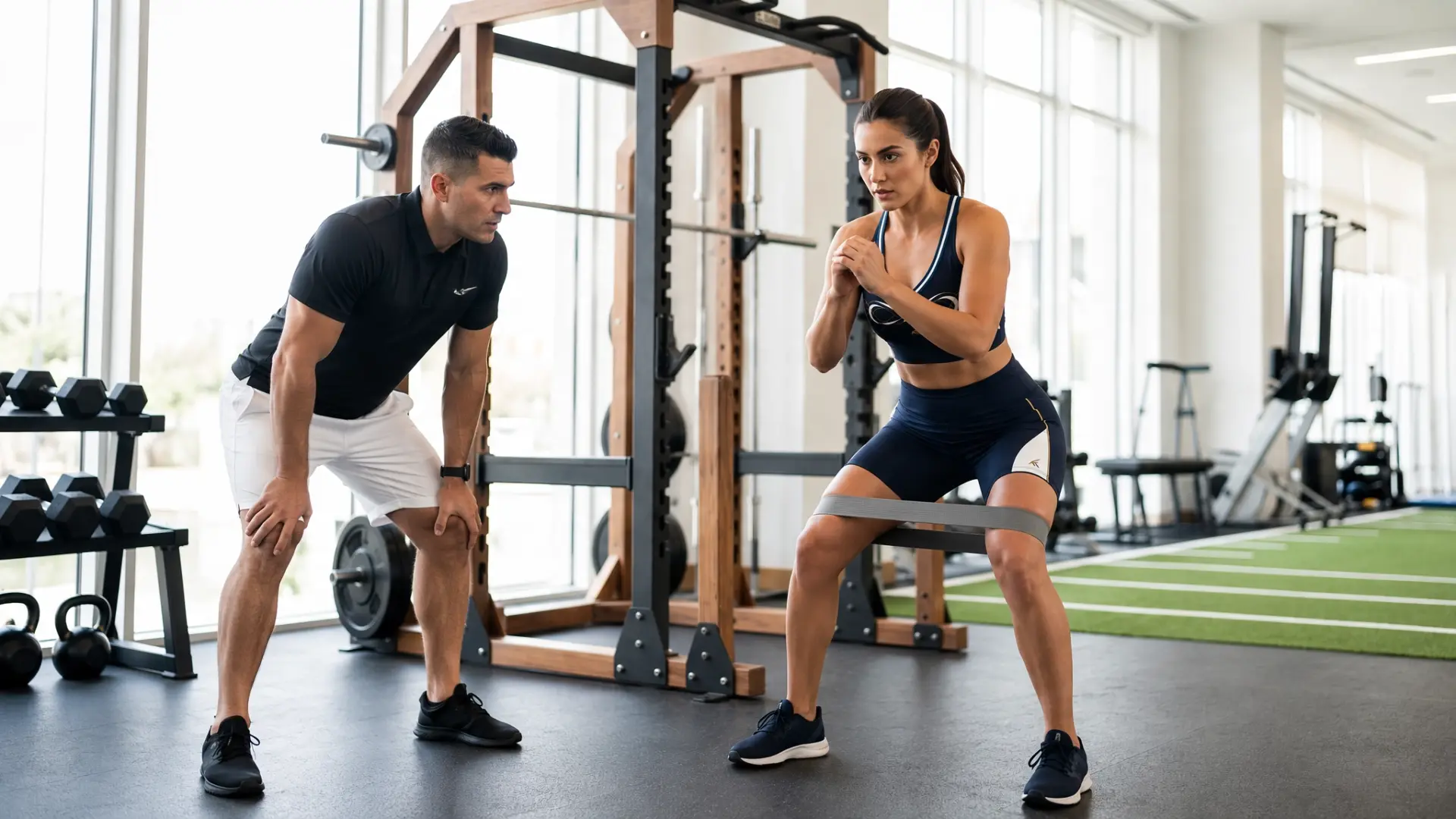
KGS FitLab · Pre-Hab / Injury Prevention
Build Capacity Before You Increase the Load.
A structured 6–8 week programme for adults who want to strengthen common areas of weakness, improve movement control and prepare their body for the demands of regular training.
Pre-Hab combines movement screening, targeted strengthening, balance and control work, progressive tendon loading and practical pre-training routines.
The aim is not to promise that injuries can be prevented.
It is to identify areas worth developing and progressively build the capacity and control you need for your training.
Programme 06 · At a glance
Prepare your body for what you love doing
- Block
- 6–8 Weeks
- Frequency
- 2 per Week
- Session
- 45 Minutes
- Formats
- Private · Small Group
The Pre-Hab / Injury Prevention system
How your block works
- 01
Screen
- 02
Prioritise
- 03
Strengthen
- 04
Load
- 05
Re-test
- 06
Maintain
Your progress — what we track
Movement screen
Start → re-test
Strength balance
Start → re-test
Control under load
Start → re-test
Re-test results
Start → re-test
Programme Overview
Training places repeated demands on your body.
Those demands can change as you increase training volume, intensity, running, lifting or sport-specific activity.
Pre-Hab starts by screening your movement and identifying a small number of priority areas to work on.
From there, the programme uses targeted strength, control and progressive loading to develop those areas over time.
You'll finish with a practical maintenance routine that can be incorporated into your normal training.
What You'll Work Towards
Depending on your starting point and training goals, the programme may help you develop:
- Greater strength in commonly under-trained areas
- Better single-leg balance and movement control
- Improved trunk and rotational control
- Greater shoulder and scapular control
- Better tolerance to progressive loading
- More confidence with loaded and reactive movement
- A short pre-training activation routine you can maintain
Individual outcomes depend on your starting point, training history, workload and consistency.
Programme Structure
Block Duration 6–8 Weeks
Frequency 2 Sessions Per Week
Session Length 45 Minutes
Formats Private · Small Group · [Confirm Couples]
Fees, venues and weekly times are published on the Master Schedule & Pricing page.
The published FitLab session rates are 2,000–2,700 QAR for 12 private sessions, 2,500–3,500 QAR for 16 private sessions, 4,400 QAR for 12 Couples sessions, 5,600 QAR for 16 Couples sessions, and Small Group from 900 QAR per person. These are general FitLab rates, not confirmed Pre-Hab package prices or inclusions. Please confirm Couples availability with the team.
The separate KGS PIS STRIVER™ fitness self-assessment is not the Pre-Hab movement screen and is not included in this programme.
What We Develop
01 — Movement Screening & Priority Identification
Start with a movement screen and relevant training/injury history.
The goal is to identify areas that may benefit from additional strength, mobility or control work.
Rather than trying to address everything at once, we'll establish two to three priority areas for the programme.
02 — Ankle & Foot Strength
Develop strength and control through the feet and ankles to support standing, running, jumping and other lower-body movements.
The exercises and loading are matched to your current ability and training demands.
03 — Knee & Hip Control
Develop single-leg control, hip strength and lower-limb coordination.
The focus is on producing and controlling movement under progressively greater demands.
04 — Lower Back & Trunk Strength
Build bracing, anti-rotation and trunk-control capacity that can support loaded movement.
Exercises are progressed according to your training level and goals.
05 — Shoulder & Scapular Control
Develop shoulder strength and scapular control for pressing, pulling, overhead movement and other upper-body demands.
06 — Tendon & Load Tolerance
Use gradual, controlled loading to develop tolerance to the demands placed on relevant tissues.
Progression is based on your current capacity rather than simply adding more work each session.
How The Programme Works
01 — Screen
Complete a movement screen and review your relevant training and injury history.
02 — Prioritise
Identify two to three areas that are most relevant to your current training needs.
03 — Strengthen
Build targeted strength and movement control around those areas.
04 — Progress
Gradually increase resistance, range, complexity or loading demands as appropriate.
05 — Re-Test
Repeat relevant measures to assess changes in movement control, balance and strength.
06 — Maintain
Finish with a practical routine that can be incorporated into your normal training week.
A Typical Week
2 × Coached Sessions
Screen-driven strengthening, balance, control and progressive loading based on your programme.
Weekly
Re-test or review your two priority areas and adjust the programme where appropriate.
Ongoing
A short pre-training activation routine — typically around 10 minutes — that you can use before relevant training sessions.
How We Measure Progress
Progress is tracked using relevant measures rather than relying only on how you feel.
Depending on your programme, these may include:
- Movement screen results
- Single-leg balance and control tests
- Isometric strength holds
- Relevant range-of-motion measures
- Reported frequency of training niggles
- Training days missed
These measures help us monitor changes over the programme and decide what should be progressed or maintained.
Who Is This Programme For?
Adults With Recurring Training Niggles
If small aches or recurring niggles regularly change how you train, the programme can help you identify areas to work on and build capacity progressively.
Recreational Athletes
Useful for adults who regularly play football, run, lift, cycle or participate in other sports and want structured supporting strength work.
People Increasing Training Load
If you're increasing your running, lifting, sport participation or overall training volume, additional strength and control work may be useful alongside your main training.
People Returning To Training After Rehabilitation
If you have completed clinical rehabilitation and have been cleared to return to training, Pre-Hab can provide a structured bridge into general fitness or sports training.
Who Is It Not For?
Active Injury Requiring Diagnosis or Treatment
Pre-Hab is a fitness coaching programme, not a substitute for medical diagnosis, physiotherapy or clinical rehabilitation.
If you currently have an injury requiring assessment or treatment, seek the appropriate healthcare professional first.
People Looking For a Guaranteed Injury-Proof Programme
No training programme can guarantee that you will avoid injury.
This programme is designed to identify relevant areas for development and progressively build strength, control and load tolerance.
People Unwilling To Train The Basics
A significant part of Pre-Hab is consistent, controlled work.
The exercises may not always be the most exciting part of your training, but consistency is necessary for development.
Why It Matters
Your training capacity is influenced by more than the main workout.
Strength, balance, movement control, tissue loading and recovery all contribute to how well you handle your training demands.
Pre-Hab gives these areas a dedicated place in your programme instead of waiting until they become an afterthought.
The objective is simple:
Build the capacity you need for the training you want to do.
Pre-Hab vs. Rehabilitation
Pre-Hab and rehabilitation are not the same thing.
Rehabilitation is generally used to address an existing injury or medical condition under appropriate clinical guidance.
Pre-Hab is a fitness programme focused on strengthening, movement control and preparation for training demands.
If you are currently injured, the appropriate starting point may be clinical assessment rather than Pre-Hab.
Will This Replace My Main Training?
No.
Pre-Hab is designed to complement your main training rather than replace it.
The programme can be used alongside strength training, running, football and other recreational activities where the overall training load is appropriate.
Your coach can help determine how the sessions fit into your existing week.
Will It Help With Football?
It can support physical qualities that are relevant to football, including:
- Single-leg strength and control
- Lower-limb strength
- Trunk control
- Shoulder stability
- Tendon loading
- Balance and coordination
However, Pre-Hab does not replace football-specific technical, tactical, speed or conditioning training.
Frequently Asked Questions
Choose Your Training Format
Private — 1-on-1
A dedicated coach and programme built around your movement needs, training history and goals.
- Dedicated coach
- Personalised programme
- Progress tracking
- Flexible scheduling
Couples — 2 People
Train with a partner, friend or family member under one coach and a shared structure.
- Train together
- Shared programming
- Mutual accountability
- Same coach
[Confirm availability for this programme]
Small Group
Coached sessions with structured progression and group accountability.
- Coached sessions
- Structured progression
- Shared environment
- Group accountability
Ready To Build More Training Capacity?
Start with a movement assessment and we'll determine which areas are most relevant to your current training, starting point and goals.
Or view available formats, venues and session times:
Coming soon
Meet your coach
Coach profile, qualifications and introduction coming soon. Ask us who will lead your block.
Ask the teamComing soon
Real client progress
Consented client stories and progress results coming soon. Ask us about recent outcomes.
Ask the teamNot sure this is your programme?