
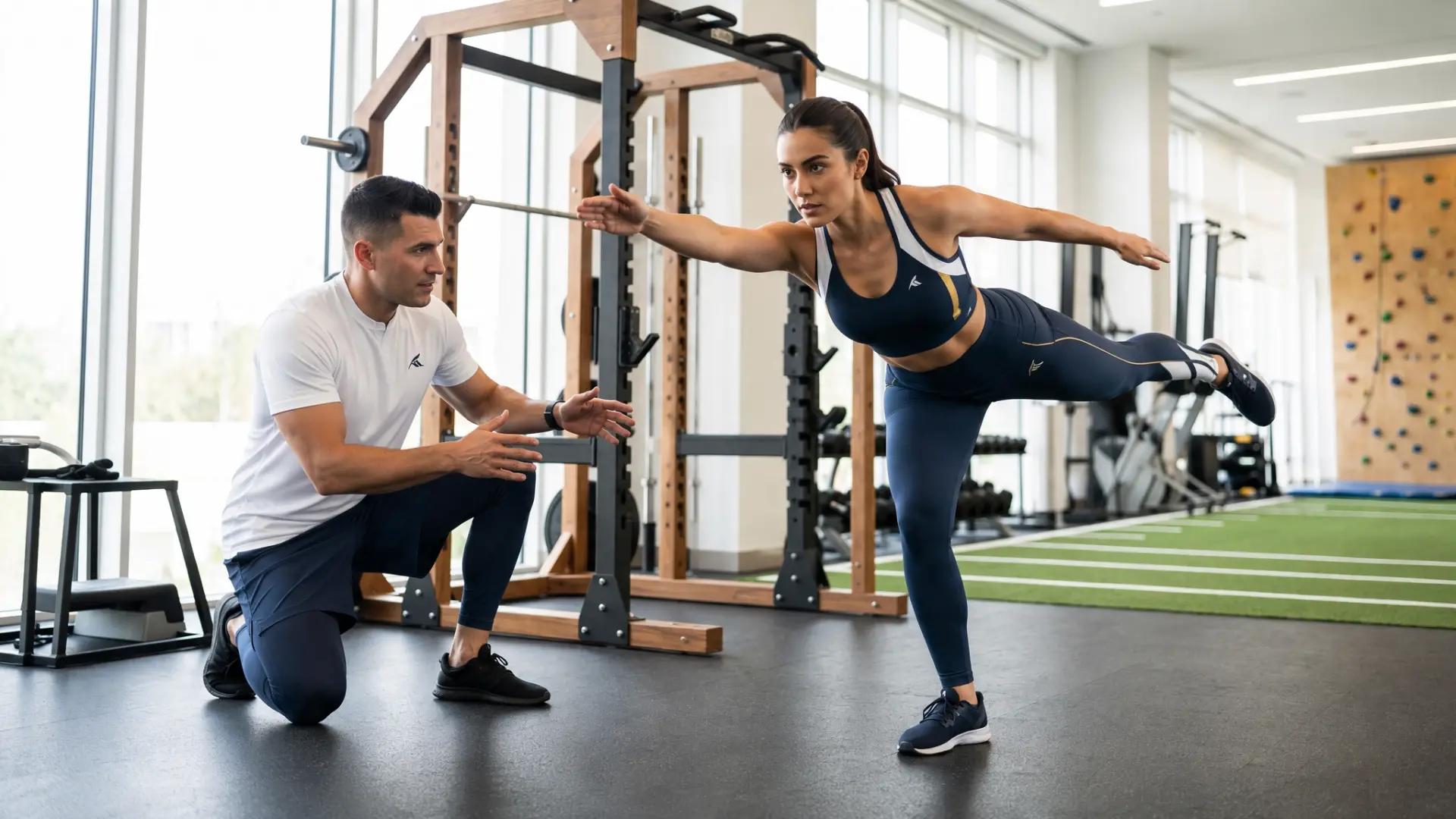
KGS FitLab · Posture Fix
Move More Freely. Build Better Postural Control.
A structured 4–8 week programme for people dealing with stiffness, limited mobility, rounded-shoulder or forward-head positions, and the effects of prolonged sitting.
Posture Fix combines movement assessment, mobility work, targeted strengthening and practical workstation habits to help you move and position your body more comfortably.
Ask about my posture assessment
4–8 weeks · 2 sessions per week · 45 minutes · Private · Small Group
Ask the team whether Couples coaching is available for Posture Fix.
Programme 04 · At a glance
Better postural control for desk-bound life
- Block
- 4–8 Weeks
- Frequency
- 2 per Week
- Session
- 45 Minutes
- Formats
- Private · Small Group
The Posture Fix system
How your block works
- 01
Assess
- 02
Mobilise
- 03
Control
- 04
Strengthen
- 05
Adapt
- 06
Re-check
Your progress — what we track
Movement screen
Start → re-test
Range of motion
Start → re-test
Daily-habit adherence
Start → re-test
How you feel
Start → re-test
Sitting All Day Can Change How You Move
Hours spent sitting, driving or working at a desk can be associated with stiffness, reduced movement and changes in how you position your head, shoulders, hips and spine.
But posture isn't simply about trying to "sit up straight."
It involves:
Mobility Can you access the range of movement you need?
Control Can you actively maintain useful positions?
Strength Can the relevant muscles support those positions?
Habits Does your working environment encourage you to stay in the same position for hours?
Posture Fix addresses all four.
The goal is not to force you into one perfect posture.
The goal is to help you develop better movement options, control and habits that you can use during everyday life.
Is Posture Fix Right For You?
This programme is designed for adults who:
- Spend long periods sitting or driving
- Notice stiffness after sitting for extended periods
- Notice rounded shoulders or a forward-head position
- Feel restricted through the upper back, hips or shoulders
- Want to improve their movement before beginning or progressing strength training
- Want a structured programme rather than occasional stretching
- Want practical exercises they can continue between sessions
It may also be appropriate if your goal is to develop better movement habits around your workstation or daily routine.
Posture Fix is NOT intended as a treatment for acute or undiagnosed pain.
If you have significant, persistent, worsening or unexplained pain, seek assessment from an appropriately qualified medical or clinical professional before starting exercise.
What You'll Work Towards
Better Movement, Not A "Perfect Posture"
Improved Mobility
Work on areas where restricted movement may be limiting your comfortable range.
Better Postural Control
Develop the strength and control needed to maintain useful positions.
More Comfortable Movement
Work towards easier movement through the neck, shoulders, upper back, hips and other relevant areas.
Better Workstation Habits
Identify practical changes that can reduce prolonged static positioning.
A Simple Daily Routine
Use a short routine between coached sessions to reinforce the work.
Ask the team about the daily routine duration and whether it is provided in your format.
How Posture Fix Works
Assessment → Mobility → Control → Strength → Habits → Re-check
01 — ASSESS
We start by looking at your posture and movement.
This can include:
- Postural photographs
- Range-of-motion assessment
- Shoulder and hip movement
- Wall and overhead tests
- Relevant movement observations Ask the team which additional assessment steps are included.
The objective is to understand where movement is restricted and where additional control or strength may be useful.
02 — MOBILISE
We work on relevant areas where limited mobility is affecting your movement.
This may include thoracic and hip mobility, depending on your assessment.
03 — ACTIVATE & CONTROL
You perform targeted exercises to improve control of the muscles involved in maintaining useful positions.
This can include:
- Deep neck control
- Scapular control
- Core control
- Glute activation Other areas depend on your assessment.
04 — STRENGTHEN
Once an appropriate range is available, we introduce strengthening exercises that help you use and control that range.
The aim is to make the movement useful — not simply temporary.
05 — CHANGE THE DAILY HABITS
Your posture doesn't only exist during a training session.
We look at practical factors such as:
- Desk setup
- Screen position
- Sitting habits
- Movement breaks
- Driving position Other workstation factors depend on your daily setting.
The objective is to make your normal environment more supportive of the changes you're working on.
06 — RE-CHECK
Your progress is reviewed through the appropriate movement and posture measures.
This can include:
- Postural photo comparison
- Range-of-motion comparison
- Wall and overhead tests
- Reported tension/stiffness
- Daily routine adherence
Assess → Work → Reinforce → Re-check
The Six Areas We Develop
01 — Postural Assessment
Identify relevant movement restrictions, positioning patterns and areas where additional control may be useful.
02 — Thoracic & Hip Mobility
Work on movement through areas commonly affected by prolonged sitting and limited daily movement.
03 — Neck & Scapular Control
Develop better control around the head, neck and shoulder-blade region.
04 — Glute & Core Strength
Build strength and control around the trunk and hips where appropriate.
05 — Breathing Mechanics
Explore rib positioning and breathing mechanics where they are relevant to your movement and exercise programme.
06 — Desk & Workstation Habits
Make practical adjustments to your environment and introduce movement breaks that are realistic for your working day.
What A Typical Week Looks Like
2 × Coached Sessions
Approximately 45 minutes per session.
Sessions can include:
Assessment / re-check → Mobility → Activation → Strengthening → Practical coaching
The exact exercises depend on your individual starting point.
Daily
A short reset routine that can be completed at your desk or during your normal day.
Ask the team to confirm the daily time commitment.
The precise routine length is confirmed with your coach.
Weekly
Your progress can be discussed regularly; ask the team when formal posture and range-of-motion measures are reviewed.
Ask the team when formal photo and range re-checks take place.
What We Measure
Progress Should Be More Than "I Feel Better."
Where appropriate, your programme can track:
Postural Photos
Compare your starting position with later stages of the programme.
Range of Motion
Track relevant shoulder, hip and other movement ranges.
Wall & Overhead Tests
Use simple movement tests to assess changes in control and available range.
Reported Stiffness / Tension
Record how you experience relevant areas over the course of the programme.
Routine Adherence
Track whether you're completing the short daily routine.
These measures provide context for your progress rather than relying on a single subjective assessment.
KGS PIS STRIVER™ also offers a separate 200 QAR fitness self-assessment covering movement quality and other training areas. It is not the Posture Fix movement screen and is not included in a Posture Fix package. Explore STRIVER™.
What Progress Can Look Like
Progress may include:
- Greater comfortable movement through relevant joints
- Improved control of the head, neck and shoulders
- Easier overhead or rotational movement
- Less stiffness after prolonged sitting
- Better awareness of working positions
- More consistent movement breaks
- Greater confidence with movement and exercise
Your results will depend on your starting point, consistency, daily habits and the factors contributing to your individual movement limitations.
Why KGS Posture Fix?
Assessment-Led
We start by looking at your movement rather than prescribing the same routine to everyone.
More Than Stretching
Mobility work is combined with activation, control and strengthening.
Built Around Daily Life
Your desk, driving and movement habits form part of the programme.
Measured
Progress can be compared using photographs, movement tests, range of motion and adherence.
Designed As A Programme
This is a 4–8 week coached process rather than a one-off posture session.
Who Is This Especially Relevant For?
Office Workers
Long periods at a desk can make movement feel restricted and create habits that are difficult to break.
Drivers
Extended periods in a seated position can contribute to stiffness and limited movement.
People Returning To Training
Improving relevant mobility and movement control can be useful before progressing a strength programme.
People Who Feel Stiff After Sitting
If getting out of a chair or car feels noticeably different from moving after you've been active, structured mobility and strengthening may help.
Suitability depends on your starting assessment.
What If I Have Pain?
Posture Fix Is Not A Medical Treatment.
The programme is designed for movement, exercise and lifestyle coaching.
It is not intended to diagnose or treat acute, unexplained or serious medical conditions.
If you have:
- Acute pain
- Unexplained pain
- Severe or worsening symptoms
- Recent significant injury
- Neurological symptoms Other symptoms that warrant clinical assessment
seek assessment from an appropriately qualified healthcare professional.
Once you're cleared for exercise, KGS can determine whether Posture Fix is an appropriate programme.
Ask the team to confirm the current screening and referral process.
Choose Your Training Format
PRIVATE
Individual Coaching
One-to-one coaching focused on your movement, goals and starting point.
Includes:
- Dedicated coach
- Individualised programme
- Movement assessment
- Progress tracking
- Flexible scheduling
Published FitLab session rates: 2,000–2,700 QAR for 12 Private sessions or 2,500–3,500 QAR for 16 Private sessions. Confirm which package and inclusions apply to Posture Fix.
SMALL GROUP
Structured Coaching With Others
Work through the Posture Fix programme in a coached small-group setting.
Includes:
- Coached sessions
- Structured progression
- Movement-focused exercises
- Group accountability
- Progress tracking
Published FitLab session rate: from 900 QAR per person for Small Group. Confirm the session count, group size and whether this applies to Posture Fix.
Ask the team to confirm the maximum group size.
These are published FitLab session rates, not confirmed Posture Fix packages. Confirm applicability, inclusions and venue. View the current schedule and pricing. Ask the team whether Couples coaching is also available.
But What If...
"I sit at a desk all day."
That's exactly the type of daily environment this programme is designed to address.
Alongside coached sessions, you'll work on practical workstation habits and movement breaks.
"Can posture actually change?"
Posture can change in response to factors such as mobility, strength, motor control, activity and habitual positioning.
The programme therefore doesn't rely on simply telling you to "sit straight."
It combines movement work with strengthening and habit changes.
"Will this fix my back or neck pain?"
Not necessarily, and we wouldn't promise that.
Pain can have many possible causes.
Posture Fix is an exercise and movement programme rather than a medical treatment.
If your pain is acute, persistent, unexplained or worsening, seek appropriate clinical assessment.
"I don't have much time."
The coached sessions are approximately 45 minutes, twice per week.
The daily routine is designed to be short and practical.
Ask the team to confirm the daily time commitment.
"Do I need to do exercises every day?"
The programme includes a short daily reset routine.
The purpose is to make the work manageable enough to fit into your normal day.
Ask the team how the home routine is delivered and tracked.
"Can I combine Posture Fix with strength training?"
Potentially.
The appropriate combination depends on your current training volume, goals, movement limitations and recovery.
If your primary objective is strength, KGS may recommend Strength Building alongside or after Posture Fix where appropriate.
If your primary objective is body composition, Body Recomposition may be more appropriate.
Ask the team whether combining programmes is appropriate for your circumstances.
"Is this physiotherapy?"
No.
Posture Fix is a KGS FitLab exercise and lifestyle coaching programme.
It does not replace physiotherapy or medical care.
Frequently Asked Questions
Ready To Work On Your Movement?
Start With An Assessment.
You don't need to diagnose your own posture or decide which exercises you need.
We'll assess your starting point and determine whether Posture Fix is appropriate for you.
Ask about my posture assessment
Ask the team about current response times and assessment availability.
What Happens Next?
01 — Tell Us What's Going On
Tell us about your workday, movement, training and main concerns.
02 — Complete Your Assessment
We'll assess relevant posture, mobility and movement factors.
03 — Confirm Your Programme
If Posture Fix is appropriate, we'll establish your programme and training format.
04 — Start The 4–8 Week Block
Work through mobility, activation, strengthening and daily-habit changes.
05 — Re-check Your Progress
Compare your movement and posture measures against your starting point.
POSTURE FIX
Move More Freely. Build Better Postural Control.
4–8 weeks · 2 sessions/week · 45 minutes
Private · Small Group
Coming soon
Meet your coach
Coach profile, qualifications and introduction coming soon. Ask us who will lead your block.
Ask the teamComing soon
Real client progress
Consented client stories and progress results coming soon. Ask us about recent outcomes.
Ask the teamNot sure this is your programme?